Asic-miners for Nervos Network - CKB mining
- Payback period calculation
- Help choosing something within your budget
- Post-purchase support
- Popular models in stock
-
- Algorithmeaglesong
- МонетыNervos Network - CKB
- Дата производства2021
-
Bitmain AntminerOut of stock
Asic-miner Bitmain Antminer K7 63.5Th/s 3080Вт (K7 63.5Th/s)
- 63.5 Th/s
- 3080
- 48,5 W/Th
- Algorithmeaglesong
- МонетыNervos Network - CKB
- Дата производства2023
-
Bitmain AntminerOut of stock
Asic-miner Bitmain Antminer K5 1.13Th/s 1580Вт (K5 1.13Th/s)
- 1.13 Th/s
- 1580
- 1,4 W/Gh
- Algorithmeaglesong
- МонетыNervos Network - CKB
- Дата производства2020


Nervos Network was launched in 2019 as an ambitious attempt to create a modular blockchain architecture. The coin was founded by developers who had previously worked on another major project — Ethereum. For a long time, the project remained overshadowed by larger cryptocurrencies, but the situation changed dramatically in 2024. The launch of the RGB++ protocol allowed Nervos to position itself as a Layer-2 solution for Bitcoin. The network’s hashrate increased from 163 PH/s at the beginning of the year to a peak of 399 PH/s (a 143% increase), and as of 2026, it is one of the most popular coins for mining. While it still lags behind industry giants in terms of market capitalization and overall popularity, it remains one of the leading mining-focused cryptocurrencies.
Eaglesong Algorithm and CKB Mining Hardware
Nervos uses its own consensus algorithm called Eaglesong. Unlike Bitcoin’s SHA-256 or Dash’s X11, Eaglesong was specifically designed for the CKB architecture, which serves as the network’s base layer.
A new block is generated every 8 seconds on the CKB network, making Nervos one of the fastest Proof-of-Work blockchains. Bitcoin generates a block approximately every 10 minutes, while Dash does so every 2.5 minutes. This high speed results in frequent reward distribution but also creates intense competition among miners.
Mining difficulty is adjusted after every block using an adaptive algorithm. The system helps prevent sharp fluctuations when large amounts of computing power enter or leave the network. Over the past year, network difficulty has more than doubled alongside the growth in hashrate.
The block reward is approximately 1,917 CKB. In November 2023, the first halving took place, reducing the reward by 50%.
The Utility of the CKB Token
CKB uses a dual-layer issuance model. The primary issuance follows a Bitcoin-like approach, featuring a fixed supply cap of 33.6 billion tokens and a halving event every four years. The secondary issuance releases 1.344 billion CKB annually with no maximum limit.
A key feature of the system is that every byte of data stored on the network requires one CKB token to be locked. The more projects use Nervos for data storage, the fewer tokens remain in circulation. This creates deflationary pressure as the ecosystem expands.
CKB maintains a correlation of approximately 0.75–0.8 with Bitcoin. When BTC rises, altcoins generally follow, often with greater volatility. In 2024, the price of CKB increased from $0.003 to a peak of $0.031, representing more than a tenfold gain.
Current ASIC Miners for Nervos Network
By 2020, CKB mining had fully transitioned to ASIC devices. Specialized chips offer significantly higher efficiency compared to general-purpose hardware.
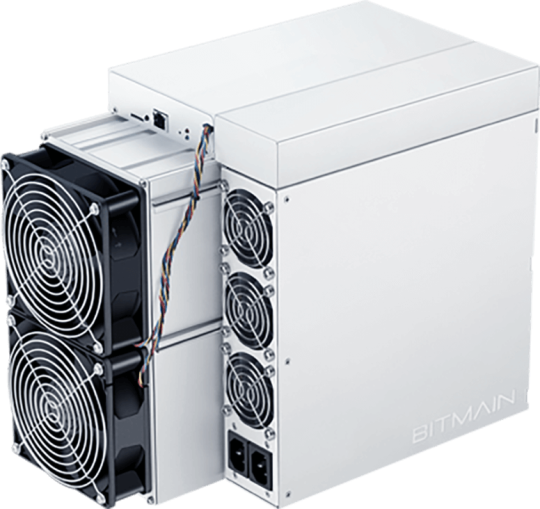
The Antminer K7 remains the only widely available ASIC miner for the Eaglesong algorithm. Released in 2022, the model is built on 7-nanometer chips. When electricity costs exceed $0.03 per kWh, profitability declines significantly.
Older models from other manufacturers have virtually disappeared from the market. Bitmain has effectively monopolized the ASIC segment for Nervos Network. Currently, there are no other mass-produced Eaglesong mining solutions available.
Hydro-cooled ASIC versions for Eaglesong are not yet available. Such solutions could reduce noise levels and allow the generated heat to be used for space heating, but the K7 relies exclusively on air cooling.